Live price: PB Fintech (NSE: POLICYBZR) on Google Finance →
There are days in the stock market when a company falls 5% or 10%, and you start looking for what went wrong.
And then there are days like September 24.
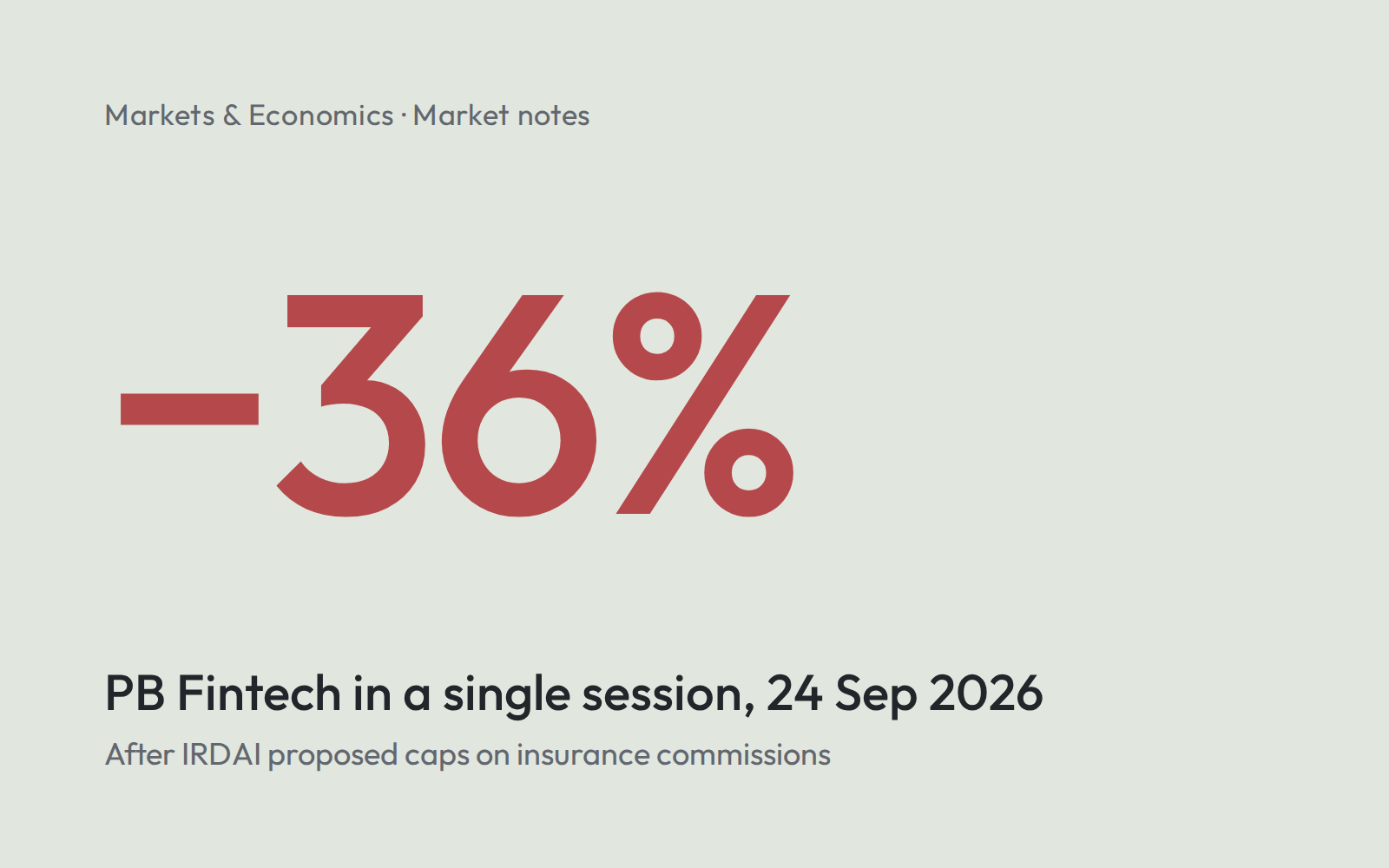
PB Fintech, the parent company of Policybazaar and Paisabazaar, fell 36% in a single session and closed at ₹1,207.20 on the NSE. More than ₹31,000 crore of market value was gone by the closing bell.
That is not a normal correction.
So, what exactly happened?
The story in one picture
- Sep 23IRDAI proposes commission capsConsultation paper on insurance distribution
- Sep 24PB Fintech falls 36%Closes at ₹1,207.20, its biggest one-day drop
- Same dayHDFC MF buys ₹321 cr25 lakh shares at ₹1,282.30, NSE bulk deal
- Oct 25Comments closeFinal rules still to come
Why distributors were hit hardest
It started with IRDAI
On September 23, the Insurance Regulatory and Development Authority of India released a consultation paper titled “Recalibrating Economics of Insurance Distribution”.
The paper proposes a fairly big overhaul of how insurance is distributed in India, and at the centre of it sits one simple question:
How much should insurers actually pay distributors to sell insurance?
The proposed framework brings back commission caps, set by product and by channel, across life, health and motor insurance. It also proposes restrictions on practices like compulsory bundling of insurance with loans.
The regulator’s broader aim is to reset the economics of insurance distribution, with more weight on customer value, transparency and keeping distribution costs in check.
The market, though, focused on just one thing:
What does this do to the economics of insurance distributors?
And that is where PB Fintech comes in
Policybazaar is, at its core, a distribution platform.
It brings insurers and customers together and earns from the policies sold through it.
So when the regulator proposes tighter limits on commissions, the first question for an investor is simple:
What happens to Policybazaar’s take rate, and its margins?
That is why PB Fintech was hit the hardest. Reuters reported that analysts saw it as one of the businesses most exposed to the proposed changes, because of how sensitive it is to commission rates.
The market wasn’t reacting to a headline.
It was repricing the economics of the business.
The reaction was brutal
PB Fintech hit multiple lower circuits through Thursday’s session before it closed at ₹1,207.20.
A 36% fall, its largest single-day decline ever, and more than ₹31,400 crore of market value wiped out, according to Reuters.
It wasn’t just PB Fintech. Insurance distributors, insurers and financial companies with a meaningful slice of insurance-distribution income were all under pressure. HDFC Life and ICICI Prudential Life, for example, also fell sharply.
But PB Fintech was clearly at the centre of the storm, for a simple reason.
For an insurer, lower commissions can mean lower acquisition costs.
For a bank, they can mean lower fee income.
For an insurance distributor, lower commissions go straight at the revenue pool.
That difference matters.
And then, something interesting happened
While the market was busy selling PB Fintech, HDFC Mutual Fund was buying.
According to NSE bulk-deal data, HDFC Mutual Fund bought 25,00,000 shares at ₹1,282.30 each, a transaction worth roughly ₹321 crore.
Think about that for a moment.
The stock was collapsing. A regulator had just put a big question mark on the economics of insurance distribution. And one institutional investor put about ₹321 crore into the stock in a single bulk deal.
Does that mean HDFC Mutual Fund believes the new rules won’t hurt PB Fintech?
We don’t know.
Does it mean the stock has bottomed?
That is definitely not something one transaction can tell you.
But it does make the day more interesting. While most of the market treated the proposal as a serious threat to PB Fintech’s existing economics, at least one large institutional investor was willing to put real money to work at those lower prices.
That is worth watching.
One more number
HDFC Mutual Fund wasn’t new to this story.
At the end of August, it already held about 2.52 crore PB Fintech shares, the largest holding among mutual fund houses, worth around ₹4,717 crore at the time.
After Thursday’s fall, that holding would be worth a lot less.
So the ₹321 crore purchase wasn’t a small, one-off trade. It came on top of an exposure that was already significant.
Again, the reasoning behind it isn’t public, and there is no point building a story around it.
But the transaction itself is a fact.
The market is questioning the model, not just the next quarter
This, to me, is the most important part of the reaction.
The market isn’t simply asking, “Will PB Fintech’s profit fall next year?”
It is asking, “At the proposed commission levels, does the Policybazaar model still work the way it does today?”
That is a much bigger question.
PB Fintech’s management has said the proposed changes could significantly affect its non-life insurance business, and that the company may respond by slowing hiring, cutting marketing spend and trimming other costs.
In other words, the company may have to rethink how it grows.
That is a structural question, not one bad quarter.
But there is another side to this
The consultation paper isn’t only about cutting commissions.
IRDAI is also trying to fix the wider economics of insurance distribution, including transparency, incentives and mis-selling. It is part of a larger attempt to bring down distribution costs and change how insurance reaches people.
From a policy point of view, that could matter well beyond any one company.
From an investor’s point of view, the transition could be uncomfortable.
And that is roughly where the market sits right now.
What happens next?
This is still a consultation paper. IRDAI has invited comments from stakeholders until October 25, 2026.
So the 36% fall shouldn’t be read as if PB Fintech’s final economics have already been decided. There are still a few open questions:
How much of the proposed commission structure survives the consultation?
When exactly does the new framework come into force?
How much of the impact can Policybazaar offset through higher volumes?
Can the company earn more elsewhere?
And perhaps the most interesting one: can a platform built on distribution commissions move to a lower-commission, higher-efficiency model?
We don’t know that yet.
What we do know is that the market has suddenly put a much lower value on the economics of the existing model.
And somewhere in the middle of all this, HDFC Mutual Fund quietly bought ₹321 crore worth of the stock.
Maybe it turns out to be a brilliant contrarian bet. Maybe it doesn’t.
For now, it is one more interesting data point on an extraordinary day for PB Fintech.
Sometimes a stock doesn’t fall because the company changed overnight.
It falls because the assumptions the market was using to value it changed.
PB Fintech had one of those days.
Sources
- Economic Times: HDFC MF buys ₹321 crore of PB Fintech, on the HDFC Mutual Fund bulk deal
- Reuters: India’s insurance reform plan tanks distribution-linked shares, on the market reaction and regulatory context
- Reuters via MarketScreener: PB Fintech to cut costs, slow hiring after commission caps, on management’s response
- Moneycontrol: Bulk and block deals on Sep 24, independent reporting of the bulk deal
- Moneycontrol: PB Fintech fall wipes out mutual fund holdings, on mutual fund ownership and HDFC MF’s existing stake
- Moneycontrol: PB Fintech, Turtlemint crash after IRDAI’s consultation paper, on the intraday reaction
- Business Standard: PB Fintech share price, for the September 24 close
- Trendlyne: Latest bulk and block deals, for the exchange-reported quantity and price