At some point, without anyone announcing it, I found myself standing in the middle of a room full of kids.
Some of them are actual kids. Small people with sticky fingers and very big questions.
The neighbour’s kid asked me last week why the moon keeps changing its shape. Why it’s round one night, a thin slice a few nights later, and then disappears. I gave him an answer I was quite proud of. For about four seconds.
Then came the next question. And then another.
That’s when I realised he wasn’t really looking for an answer. He just wanted someone to listen.
The others are kids too, just older.
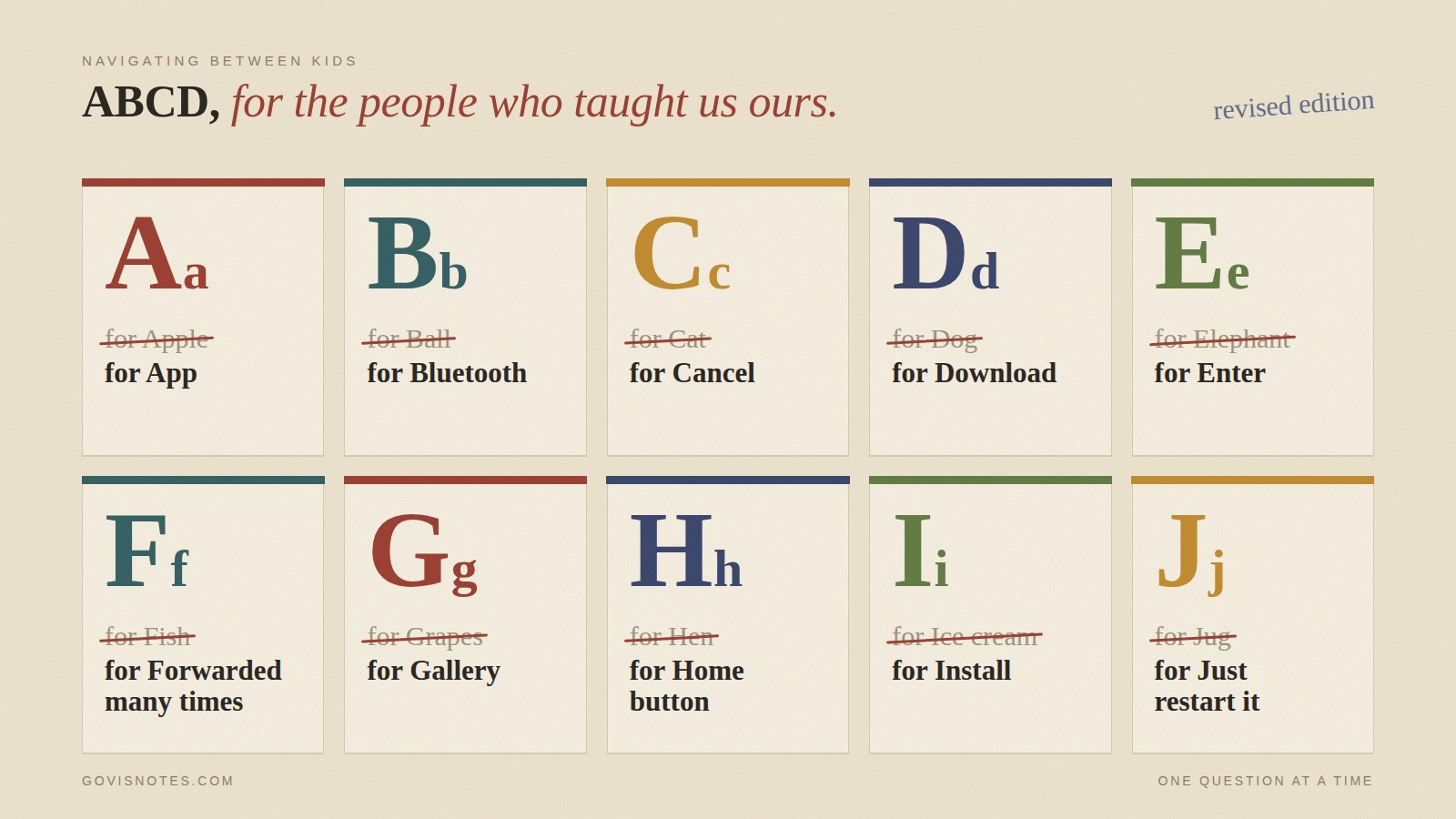
The elders at home, the people who once seemed to have an answer for everything, are slowly turning back into kids. Dad wants to know how to keep his banking apps secure, why a PDF won’t open on his phone, or why something that worked yesterday suddenly doesn’t work today. Mom wants to know how to use the desktop version of her astrology app, how subscribing on YouTube works, and which button on the smart TV remote actually does what she wants.
The same people who taught me how to cross a road now come to me to cross a screen.
They call it the cycle of life. It sounds very neat when you put it that way. Almost like something you’d find in a school textbook.
It doesn’t feel that neat when you’re actually living through it.
The in-between
I’m somewhere between these two groups.
To the little ones, I’m an adult. I’m the tall one who supposedly knows things, who can reach the top shelf, who might decide whether there’s going to be ice cream.
To my parents, I’m still a bit of a child. My opinions get a patient nod. My decisions sometimes get a second look. And yet, more and more, they come to me when the app doesn’t load, when the PIN needs changing, when nothing on the screen does what it says it should.
So I keep switching. Sometimes within the same minute. I kneel down to explain the moon to one person, then stand up and explain an app to another.
Somewhere along the way, I’m learning that both need the same thing from me: patience.
Also, the ability to repeat myself without sounding irritated.
What surprises me is how similar the two ends can be. Both want to be heard more than corrected. Both get tired faster than they admit. Both can be delighted by very small things. A biscuit. A phone call. A walk that doesn’t really have a destination.
And both, in their own way, are trying to keep up with a world that keeps changing faster than they can.
But the fix isn’t complicated. As long as you don’t put them down for asking, they’ll keep asking. They’ll keep trying.
And when you explain something in the simplest way you can, the moon as a ball reflecting sunlight, or a banking app as a locked door with one key, something happens. You realise you know more than you thought you did.
Okay. I’ve got this.
And sometimes you don’t. I’ve googled the TV remote. I’ve sat with Dad, both of us staring at a PDF that refused to open, while he watched over my shoulder.
Usually, figuring it out together is half the lesson. They don’t need me to know everything. They just need me to stay with them until we figure it out.
An old verse on a new screen
A few days ago, I was sitting with Mom while she watched Sri Kuppa Viswanadha Sarma explain the Srimad Bhagavatam on the TTD channel, one verse at a time. I was half listening and half on my phone, until this verse came up on the screen.
మాతరం పితరం వృద్ధం భార్యాం సాధ్వీం సుతం శిశుం
గురుం విప్రం ప్రపన్నం చ కల్పోఽబిభ్రచ్ఛ్వసన్ మృతఃmātaraṁ pitaraṁ vṛddhaṁ bhāryāṁ sādhvīṁ sutaṁ śiśum
Śrīmad-Bhāgavatam 10.45.7
guruṁ vipraṁ prapannaṁ ca kalpo ’bibhrac chvasan mṛtaḥ
Krishna says this to his parents, Vasudeva and Devaki. Having grown up away from them, he reflects on the debt a child owes his parents, and apologises for not being able to serve them when he was young.
In simple words, the verse says:
If you are capable of taking care of your aging parents, your wife, your young child, your teacher, the learned, or someone who comes to you for help, and you still don’t do it, then you’re only breathing, not living.
What caught my attention was the people on that list. The aging parents on one side. The young child on the other. And then, the person who comes to you for help.
That last one made me think of the neighbour’s kid and his moon question.
Traditionally, looking after someone means providing food, shelter and care. But I think it means slightly more today.
Sometimes it means helping Dad set up his banking app. Sometimes it means stepping outside to look at the moon with a kid who won’t stop asking why.
None of these things feel significant when you’re doing them. But maybe that’s what being able to care for someone looks like in ordinary life.
Boy, man, or neither
People like to ask when you become a man. I don’t know.
The older I get, the less these labels seem to matter. I’ve been responsible and irresponsible, patient and impatient, helpful and selfish. Sometimes within the same day.
I’m just human. And maybe that’s enough.
I’m slowly learning that caring for people isn’t usually about doing something extraordinary. It’s about showing up.
Again and again.
Even when you’re tired. Even when you’ve explained the same thing three times already. Even when the question seems ridiculously simple to you.
What the kids are teaching me
Maybe that’s what it means to be in the middle. The little ones remind me of who I was. The elders give me a glimpse of who I’ll become. And somewhere between the two, I’m figuring out who I am right now.
I used to think growing up meant moving further away from childhood. Now I’m not so sure. Maybe life is more circular than that.
We start by depending on others. We spend a few years learning to stand on our own. And then, slowly, the people who raised us start needing us in ways they didn’t before.
Somewhere in between, we get a few years where we’re holding hands on both sides.
I’m probably in those years now.
Some days it feels heavy. Some days I get impatient. Some days I get it completely wrong.
But then Dad opens that PDF without calling me. Mom finds her channel without shouting my name from the other room. And the neighbour’s kid points at a half moon and starts explaining to me why it looks that way.
And for now, I’m okay being here.
Maybe I’ve got this.
Maybe we’ve got this.